 6147 Morehead Road Flemingsburg, KY 41041
 Mon - Fri: 8:00 am - 5:00 pm Saturday: 8:00 am - 12:00 pm
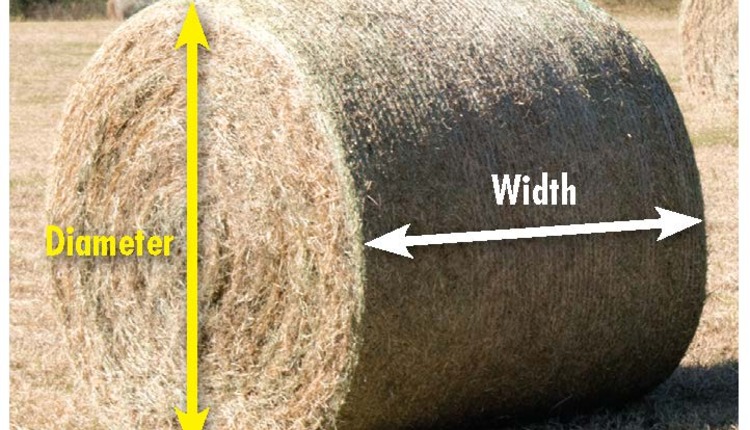
How much of a difference is there among different sized round bales?
Whether you are buying or selling round bales it’s a pretty good idea to know how much hay is really in that bale. Whether you have 4’x4′, 4’x5′, 4’x6′, 5’x5′ or 5’x6′ an astute buyer or seller should know how much is really in the bale. This discussion is purely based on the volume of the bale and for the purposes of this calculation assumes the same forage, moisture and baling pressure among the bales.
Back in that high school geometry class we learned that the area of a round surface is calculated by the equation (a=2πr). 2 times 3.14 times the radius of the bale (1/2 the diameter). This number is then multiplied by the bale width to give you a capacity measurement. Since we are using measurements in feet the capacity will be measured in cubic feet.
The purpose is to help you understand that all bales are not just alike or close to it. A 4’x5′ bale is only 2/3 the capacity of a 5’x6′ bale. Understanding this concept will help you better value the hay you are selling or buying.
| area = 2πr | bale width | cubic feet/bale | |
| 4′ x 4′ | 12.56 | 4 | 50.24 |
| 4′ x 5′ | 15.7 | 4 | 62.8 |
| 4′ x 6′ | 18.84 | 4 | 75.36 |
| 5′ x 5′ | 15.7 | 5 | 78.5 |
| 5′ x 6′ | 18.84 | 5 | 94.2 |
*This is a different but related topic: bale density would directly impact the weight of the bale but doesn’t change the bale size. The type of forage, stage of maturity, moisture content, and pressure exerted by the baler will all dramatically impact the weight of the bale regardless of bale size.



Leave a Reply
Want to join the discussion?Feel free to contribute!